Vita regularis liefert Beiträge zur weiteren Erforschung regularen Lebens in Klöstern und Orden des Mittelalters. Im Vordergrund stehen institutionsgeschichtliche Aspekte, die insbesondere auf Phänomene der Organisation und des normativen Bestandes, auf spirituelle und pragmatische Leitideen sowie auf Beziehungen zum sozialen und geistigen Umfeld im geschichtlichen Wandel zielen.
herausgegeben von
Mirko Breitenstein, Gert Melville
in Verbindung mit:
Giancarlo Andenna (Milano), Rainer Berndt SJ (Frankfurt a.M.), Michael Cusato OFM (St. Bonaventure, NY), Nicolangelo D’Acunto (Brescia), Jacques Dalarun (Paris), Marek Derwich (Wroclaw), Albrecht Diem (Syracuse, NY), Brian Golding (Southampton), Annette Kehnel (Mannheim), Brian Patrick McGuire (Roskilde), Anne Müller (Dresden), Jens Röhrkasten (Birmingham), Roberto Rusconi (Roma), Carlos Ruta (Buenos Aires), Hans-Joachim Schmidt (Fribourg), Steven Vanderputten (Gent), André Vauchez (Paris), Rudolf Weigand (Eichstätt)
mehr unter lit-verlag.de
Zuletzt erschienen
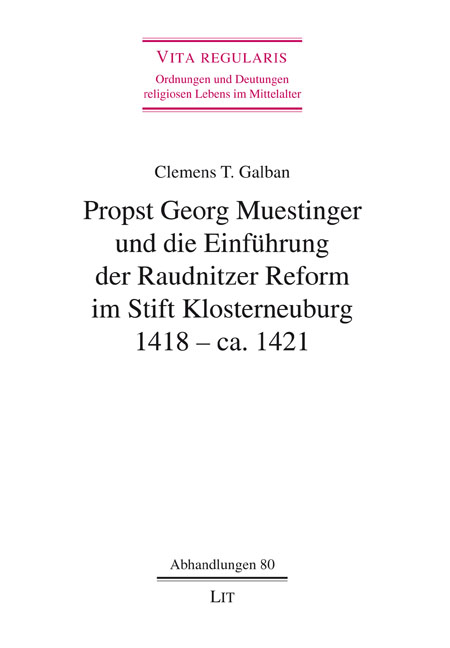
BAND 80
Das Konzil von Konstanz und die mit ihm erreichte Beendigung des päpstlichen Schismas setzten in der gesamten Kirche und insbesondere in den Orden lange aufgestaute Reformenergien frei. Infolge der österreichischen Visitation von 1418/19 wurde das altehrwürdige Stift Klosterneuburg Teil der Raudnitzer Reformbewegung der Augustiner-Chorherren und erfuhr unter seinem neuen Propst Georg Muestinger eine kulturelle Blüte. Die im Buch dargestellten Ereignisse zeigen, wie Reformkräfte sowohl zusammenwirkten als auch miteinander konkurrierten, um das Ordensleben zu erneuern. Im Mittelpunkt steht die Einführung der Raudnitzer Statuten im Stift Klosterneuburg und damit Georg Muestingers ganz eigene Adaption dieser Gesetzgebung für sein Haus.
Clemens Timothy Galban ist gebürtiger US-Amerikaner, katholischer Priester und Regularkanoniker des Augustiner-Chorherrenstiftes Klosterneuburg vor den Toren Wiens. Er erwarb seinen BA und STB an The Catholic University of America in Washington, DC, und schloss 2019 seine Doktorarbeit an der Päpstlichen Universität vom Heiligen Kreuz in Rom ab. Seitdem setzt er seine Forschungen über die Geschichte der Augustiner-Chorherren fort.
Clemens T. Galban, Propst Georg Muestinger und die Einführung der Raudnitzer Reform im Stift Klosterneuburg 1418 — ca. 1421, Bd. 80, 2021, 340 S., 34.90 EUR, br., ISBN 978–3‑643–51085‑3. Jetzt bestellen
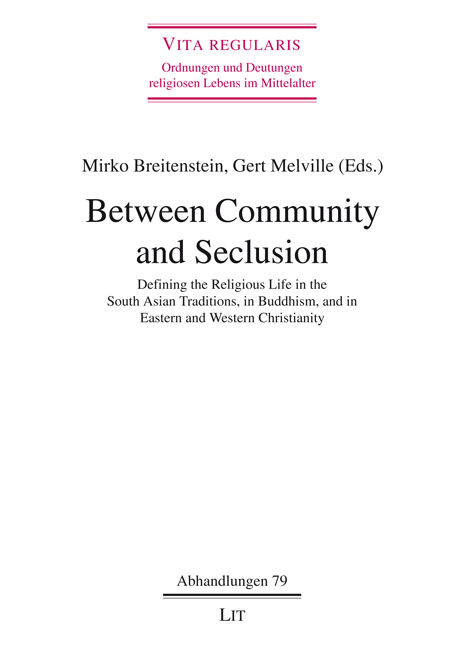
BAND 79
Defining the Religious Life in the South Asian Traditions, in Buddhism, and in Eastern and Western Christianity
The fact that certain cultures and religions produced a way of life which, for the sake of self-perfection, expected its adherents to withdraw from various obligations to the world and to enter into the organisational structure of a monastic community obviously represents a constant anthropological foundation. The spectrum of monastic life within these various cultures was extremely diverse in its manifestations. It was the result of a high degree of flexibility in the face of constantly changing ideas about piety, social needs and concepts of community and individuality.
However, an interreligious study with the aim of a scholarly analysis of comparable key elements across different monastic cultures does not exist yet. The editors as well as the authors of this volume are particularly interested in how monastic life was realised communally in many ways according to fixed norms and rules, how it shaped the understanding of community and civilisation and therefore made a decisive contribution to the formation of our cultural identity.
Mirko Breitenstein, Gert Melville (Eds.), Between Community and Seclusion. Defining the Religious Life in the South Asian Traditions, in Buddhism, and in Eastern and Western Christianity, Bd. 79, 2020, 202 S., 29.90 EUR, br., ISBN 978–3‑643–14875‑9. Jetzt bestellen
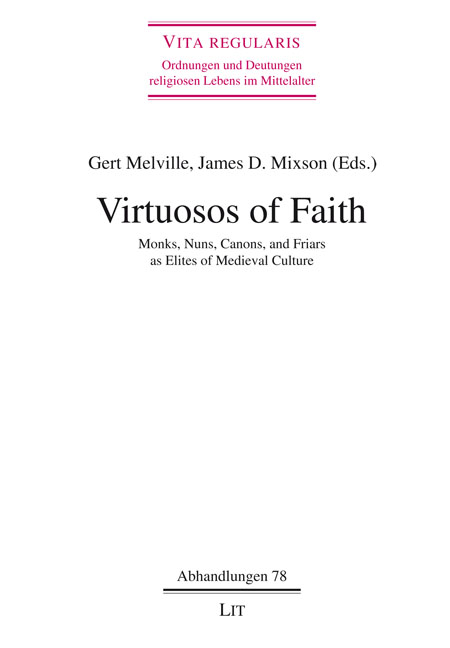
BAND 78
Monks, Nuns, Canons, and Friars as Elites of Medieval Culture
For over a thousand years, monks, nuns, canons, friars, and others under religious vows stood at the pinnacle of Western European society. For their ascetic sacrifices, their learning, piety, and expertise, they were accorded positions of power and influence, and a wide range of legal, financial and social privileges. As such they present an important opportunity to consider the nature and dynamics of an “elite” in medieval culture. Using medieval religious life as their interpretive lens, the essays of this volume seek to uncover the essential markers of elite status. They explore how those under vows claimed and manifested elite status in complex spiritual, temporal, and social combinations. They explore the workings of elite status from day to day, across region and locale — who earned recognition and how, whether through specific achievements or the deployment of specific capacities; who recognized, conferred, or helped maintain elite status, how and why; how elite status could be redefined, contested or rejected. The essays also seek to understand how medieval European religious elites compared to those found in other cultures and settings, from Syria and South Asia to the early modern transatlantic world.
Gert Melville, James D. Mixson (Eds.), Virtuosos of Faith, Monks, Nuns, Canons, and Friars as Elites of Medieval Culture, Bd. 78, 2020, 338 S., 49.90 EUR, br., ISBN 978–3‑643–91363‑0. Jetzt bestellen
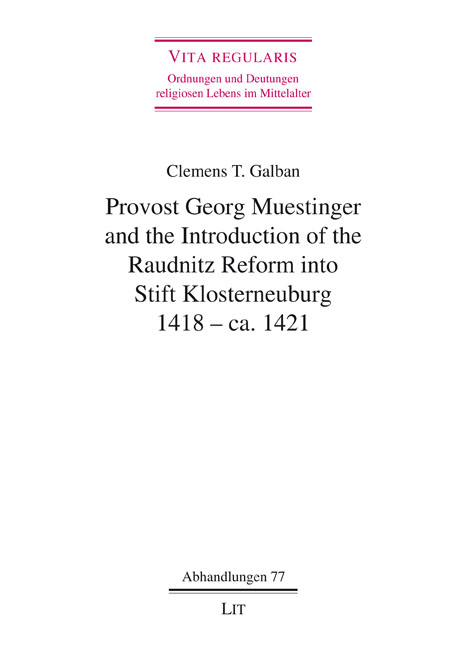
BAND 77
The Council of Constance and the conclusion of the Papal Schism released long pent-up energies of reform throughout the Church and in the religious Orders in particular. The Austrian Visitation of 1418/19 which propelled Georg Muestinger to the highest position in Stift Klosterneuburg and introduced the Raudnitz Reform of canons regular into his ancient monastery, illustrates how these energies both cooperated and competed with each other to achieve a reform of religious life. The centerpiece of this work is the introduction of the Raudnitz Statutes into the monastery and Muestinger’s adaptation of that legislation.
Clemens Timothy Galban is a native of the USA, a Catholic priest and canon regular of St. Augustine of Stift Klosterneuburg outside Vienna, Austria. He completed his doctoral work in 2019 at the Pontifical University of the Holy Cross in Rome and continues his research into the history of the canons regular from his monastery.
Clemens T. Galban, Provost Georg Muestinger and the Introduction of the Raudnitz Reform into Stift Klosterneuburg, 1418 — ca. 1421, Bd. 77, 2021, 312 S., 34.90 EUR, br., ISBN 978–3‑643–91197‑1. Jetzt bestellen